Working Memory Training Programs
HeadApp's Working Memory programs train the ability to hold information in mind, update it quickly, and use it to respond accurately. Clinically, this supports attention control, concentration under distraction, reasoning, and learning - skills that directly affect following instructions and completing multi-step everyday tasks.

Patient/Client Task
Across these Working Memory programs, the patient/client typically:
- Encodes brief information (a card, a position, or multiple cards),
- Keeps it active while new information appears, and
- Responds by detecting matches, identifying locations, ordering items, or updating what must be remembered.
Settings (All WM Programs)
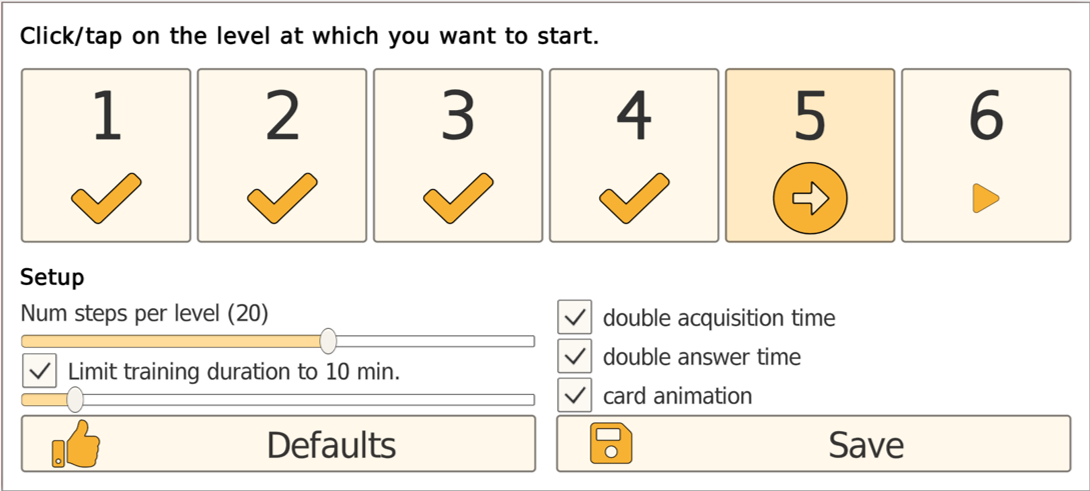
Steps per level: Defines how many consecutive successful items are needed before difficulty increases. Errors reduce progress toward leveling up. Higher values keep the patient longer at a level to consolidate success.
Limit training duration: Run with or without a time limit - useful for fatigue management, fixed session lengths, and home programs.
Double acquisition time / double answer time: Extends time to memorize (acquisition) and/or respond (answer time) - helpful for slowed processing speed and reduced endurance.
Level Progression (Adaptive)
Each Working Memory program includes multiple difficulty levels (across the suite, 53 levels total) and adapts automatically to performance. Difficulty typically increases by adding more items, more positions, faster pacing, or more complex rules. If errors rise, difficulty can decrease so the patient/client can stabilize at a manageable level before progressing again.
Progress Tracking
Progress is saved automatically, and the next session can resume at the difficulty level where the previous session ended. The Results view supports reviewing trends over time for goal setting, plan adjustments, and documentation.
N-Back: Working Memory Span
What is Trained
Memory span, sustained attention, rapid updating.
Patient/Client Task
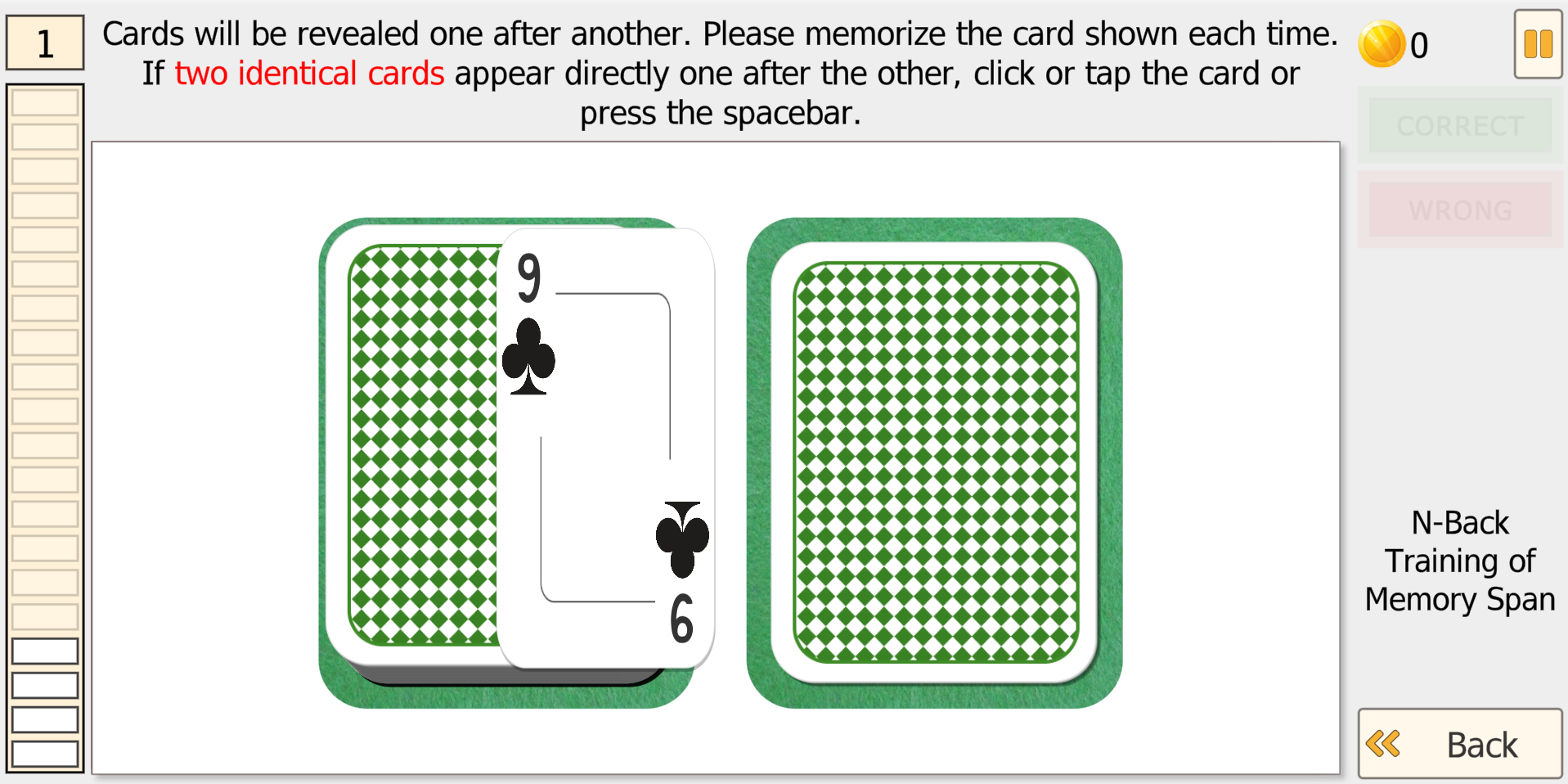
Cards appear one after another. The patient responds when the current card matches the card shown one step back (1-back) or two steps back (2-back). Depending on the level, the match can be based on the exact card, suit/color, or point value.
How It Gets Harder
Shifts from 1-back to 2-back and increases the complexity of what must be compared.
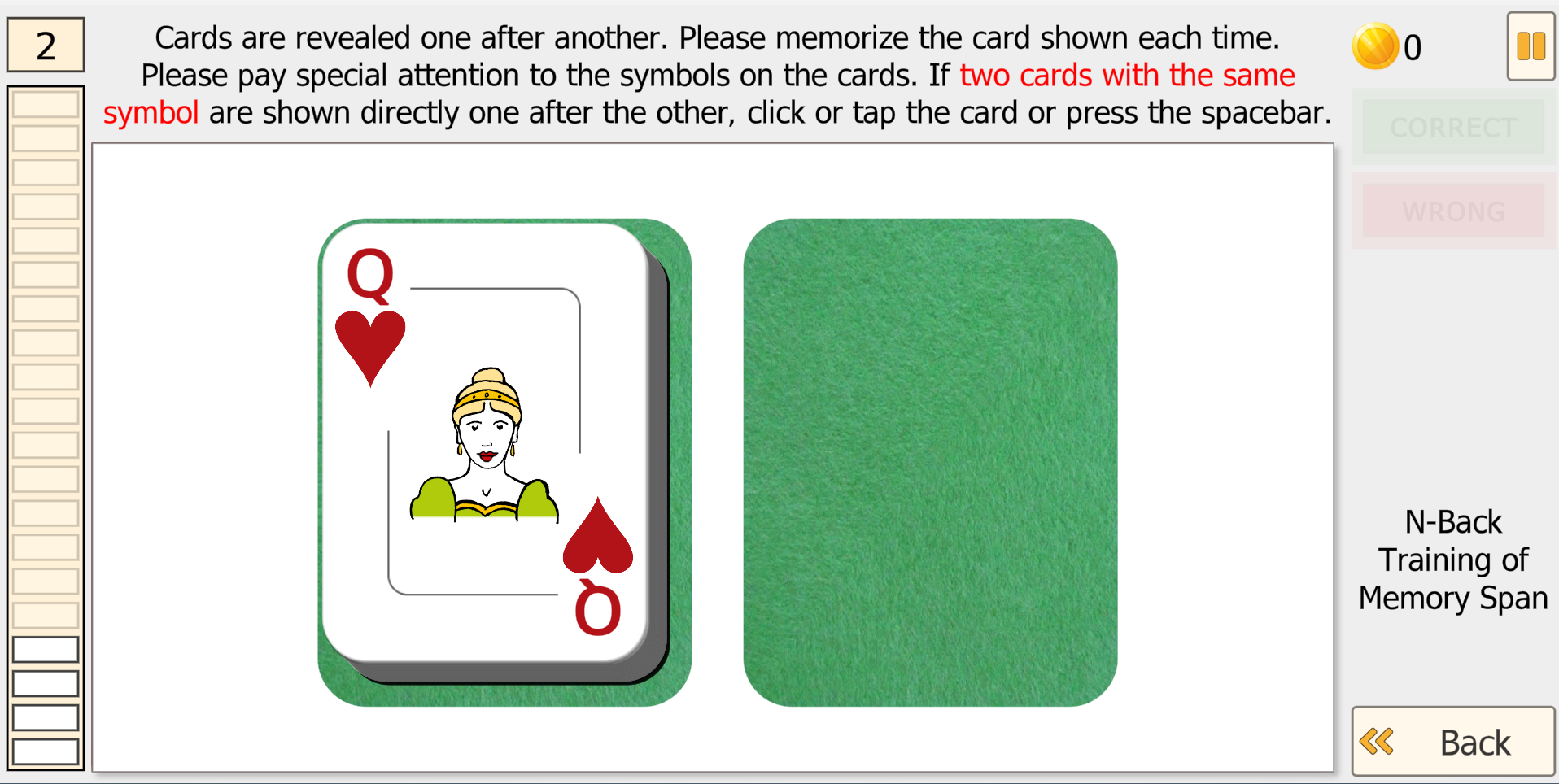
Level 2 - Match by symbol
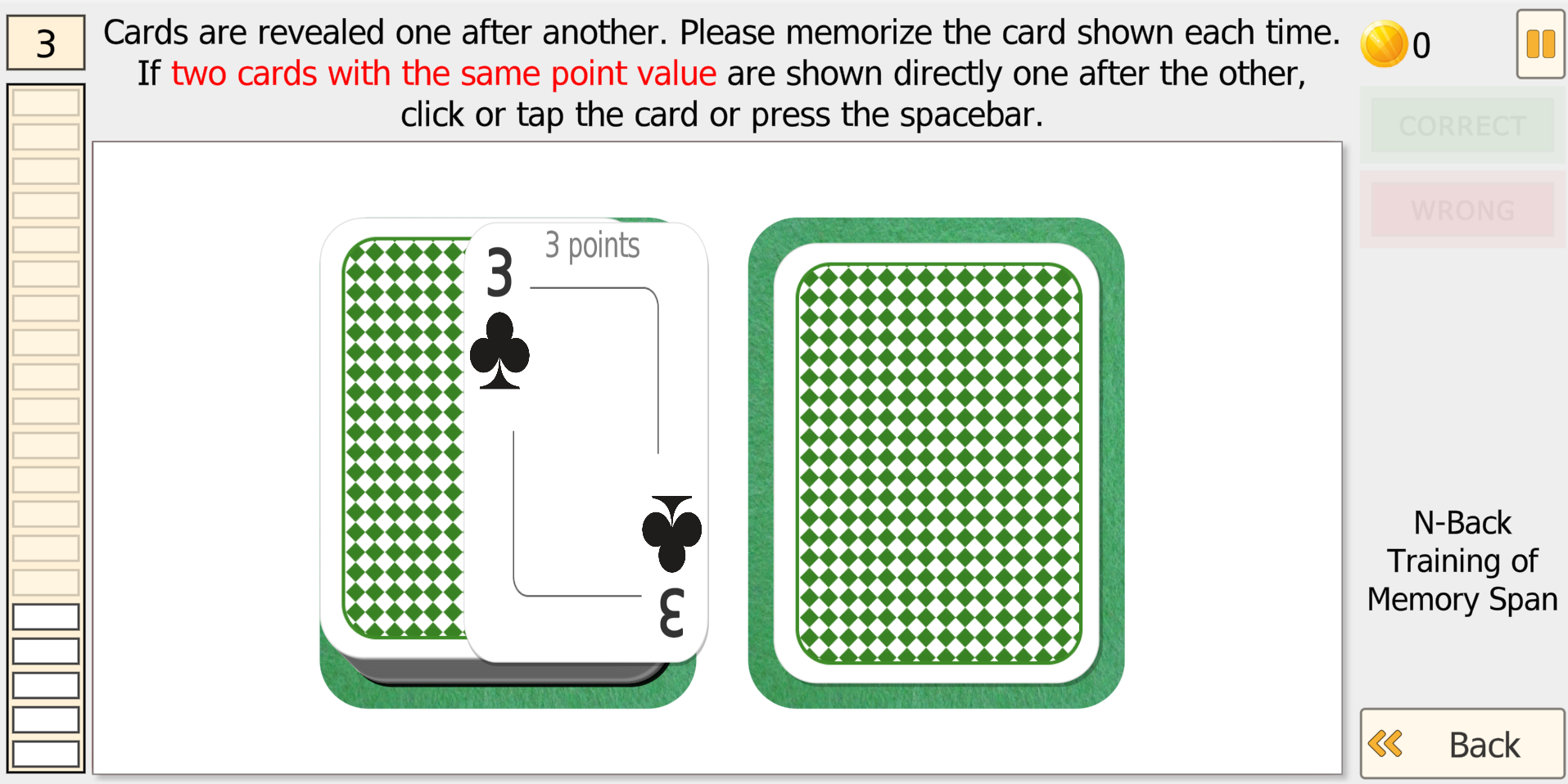
Level 3 - Match by point value
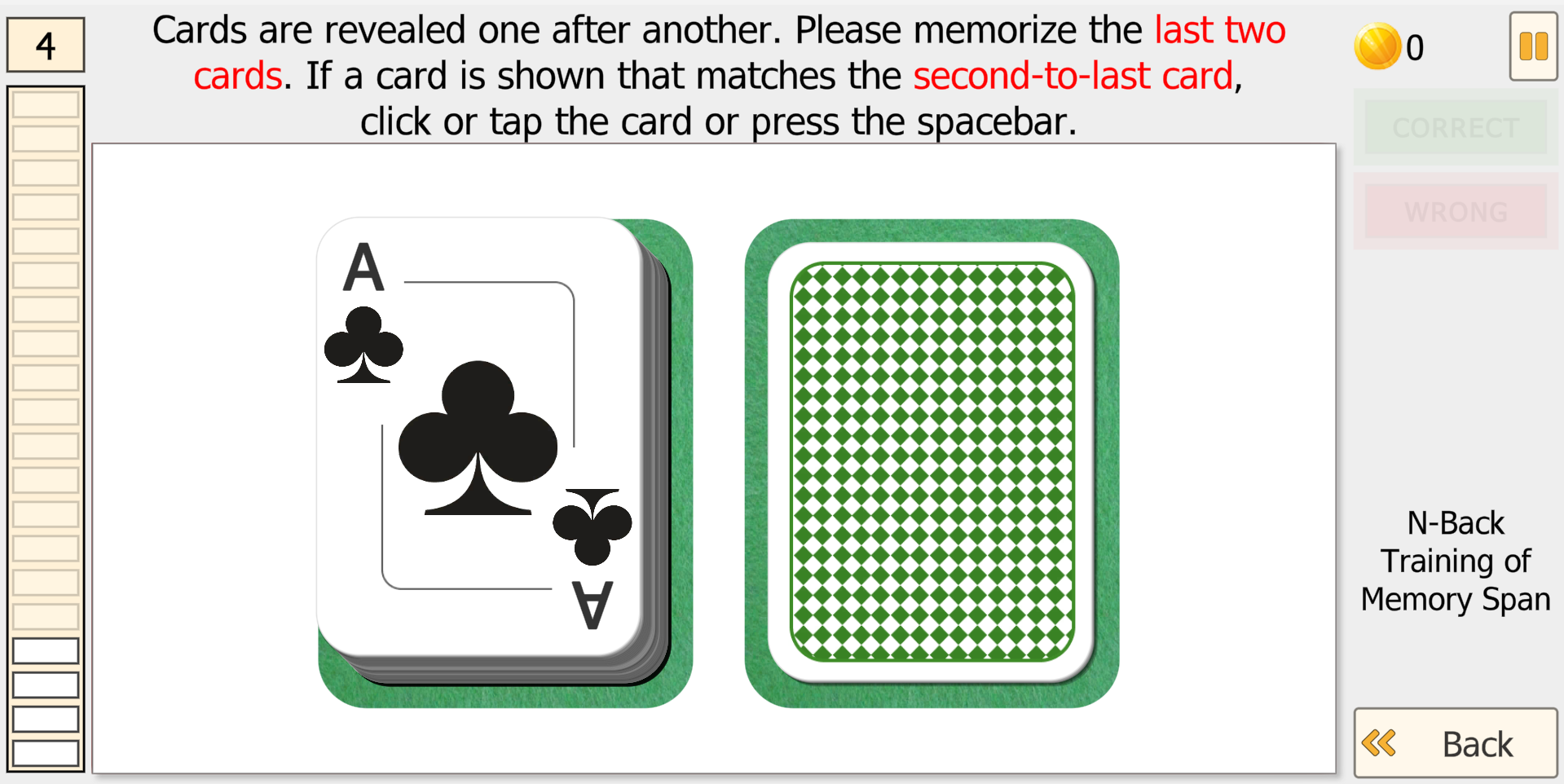
Level 4 - 2-back matching
Verbal Working Memory
What is Trained
Holding and updating verbal/semantic card information and linking it to a location (which pile).
Patient/Client Task
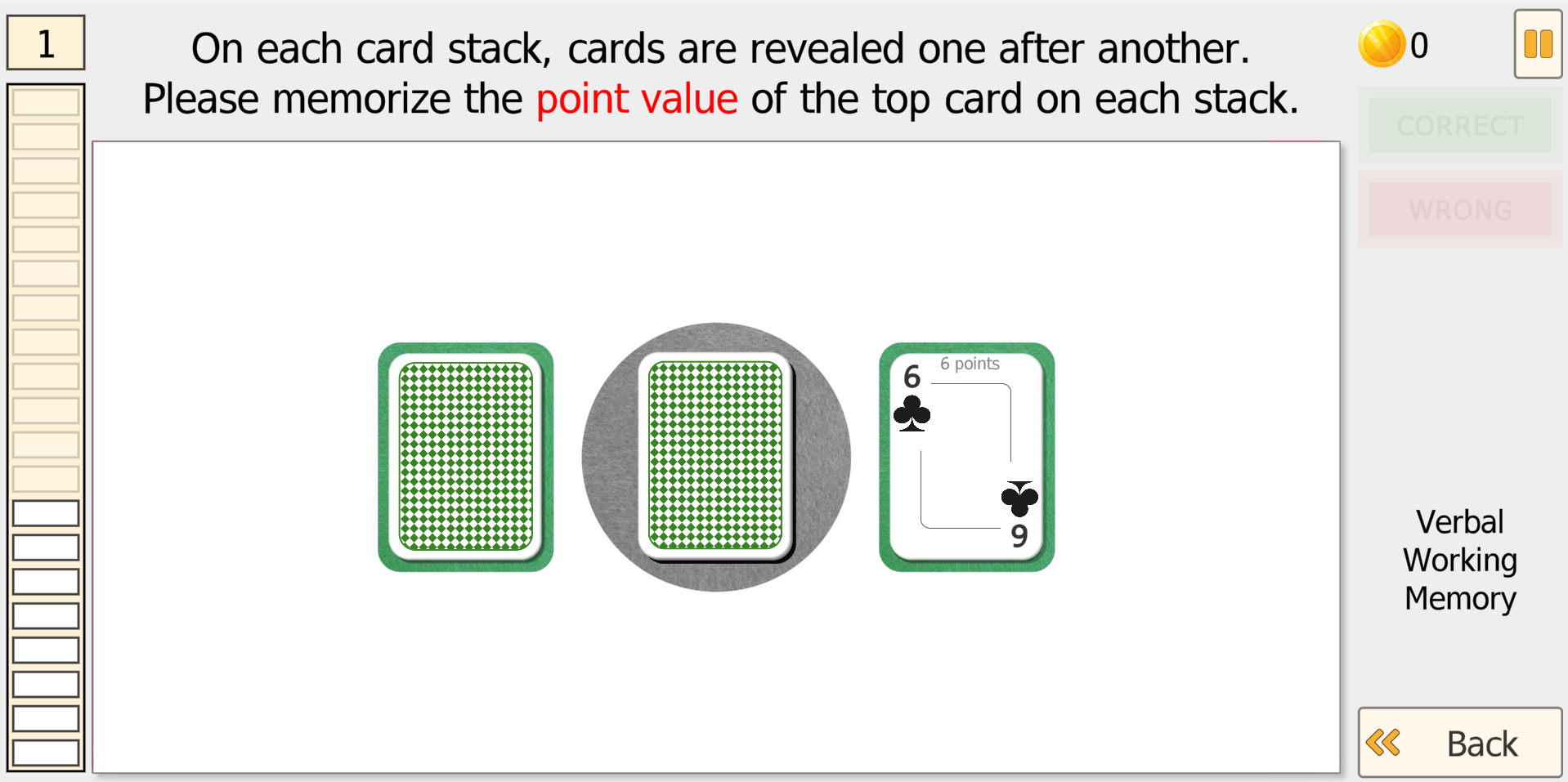
Multiple piles of cards are updated as new cards are revealed. The patient answers questions such as which pile contains a specific card/suit or which pile has the highest total points, requiring continuous updating as the piles change.
How It Gets Harder
More piles, more information to integrate, and more complex question formats.
Visual Working Memory
What is Trained
Visuospatial working memory and continuous updating without relying on card values.
Patient/Client Task
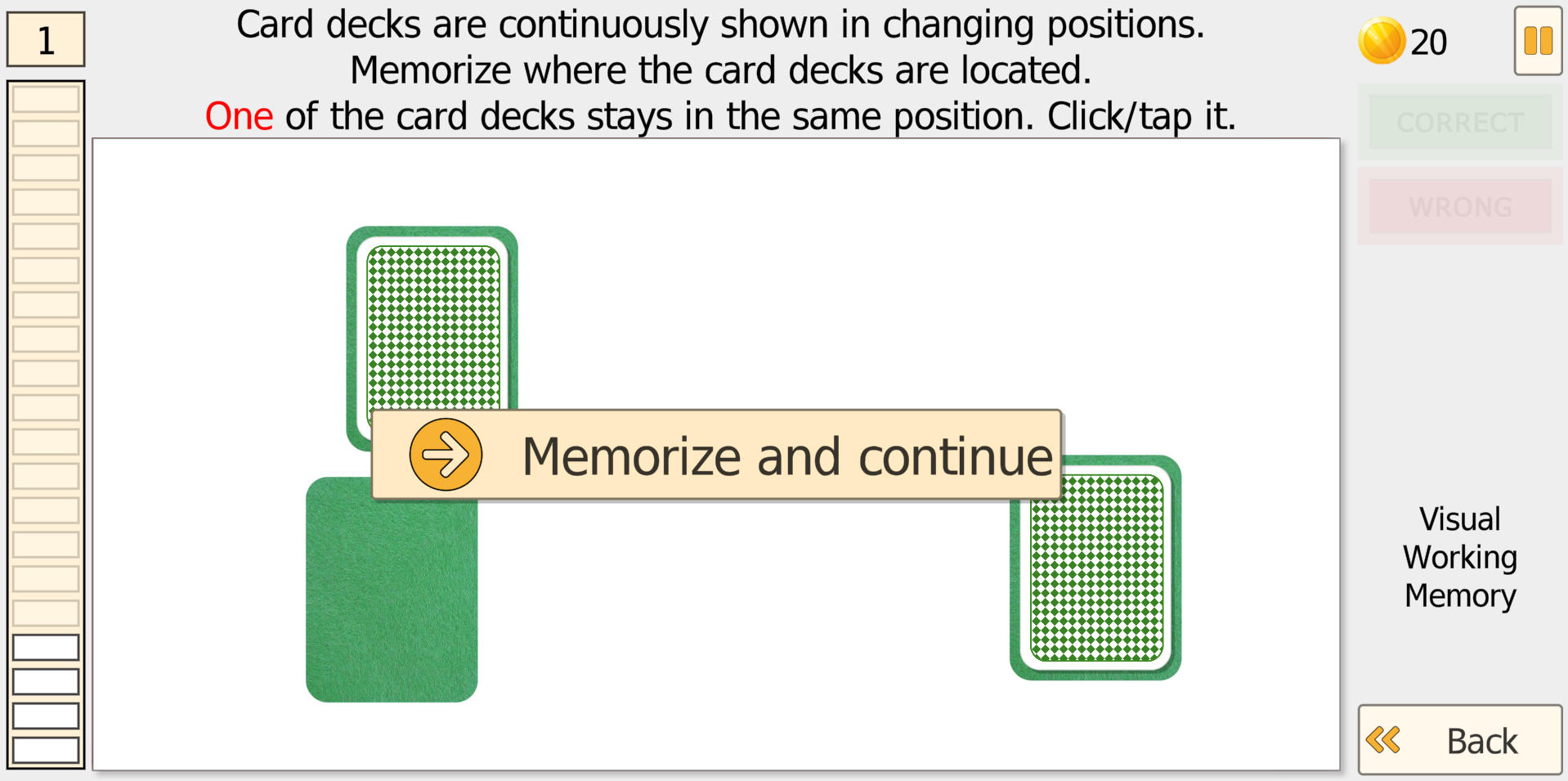
The patient memorizes positions of cards across several locations. After the cards are hidden and positions change, the patient identifies the position(s) that stayed the same (or the stable location), which demands ongoing monitoring and rapid updating.
How It Gets Harder
More cards, more possible positions, and faster or more complex position changes.
Verbal + Visual Working Memory
What is Trained
Binding "what" (card identity/value) with "where" (position), then manipulating that information.
Patient/Client Task
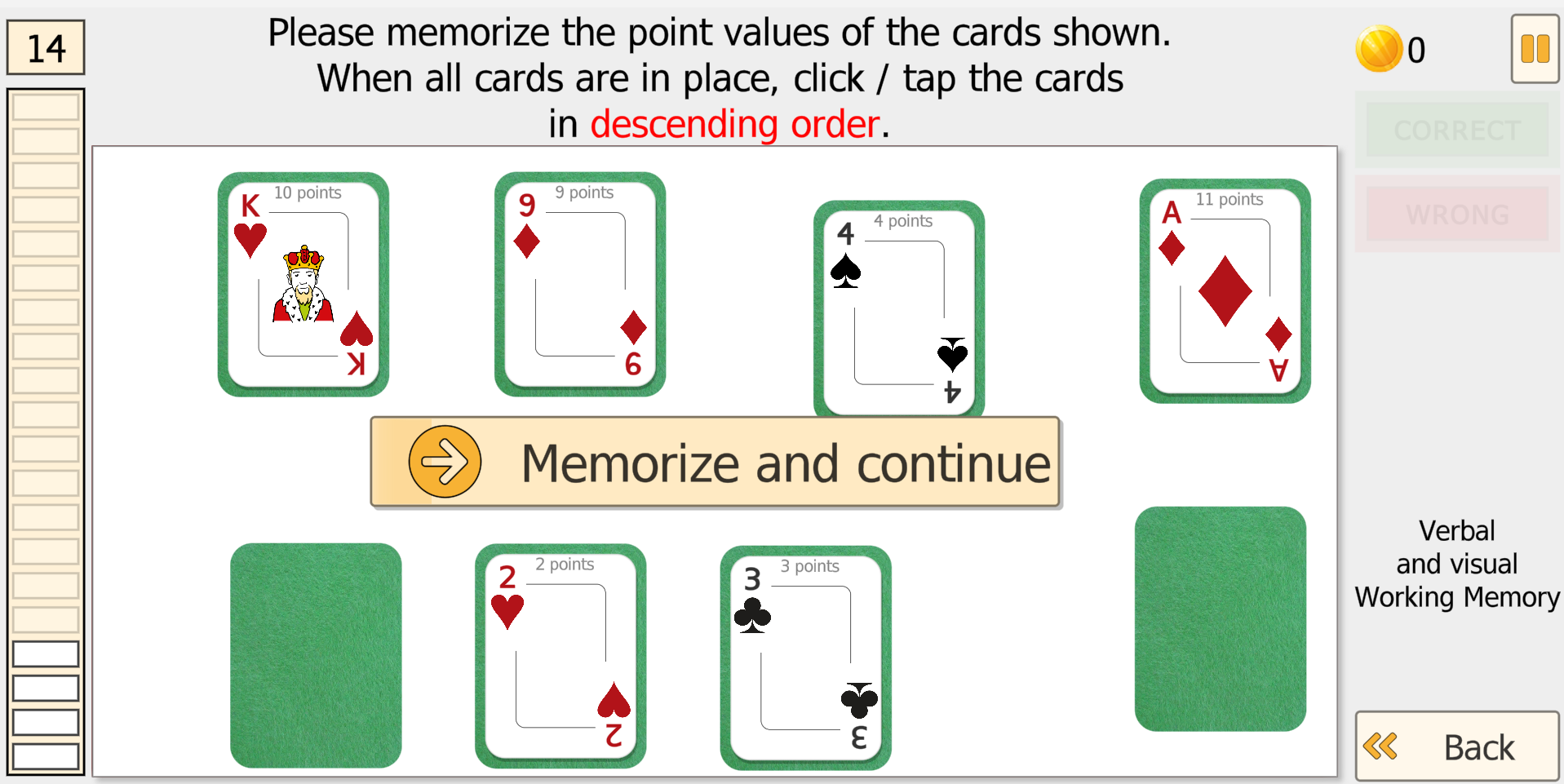
The patient memorizes which card is in which position. After the cards are hidden, they select the cards in a required sequence (e.g., ascending or descending order), relying on both identity and location memory.
How It Gets Harder
More positions, more cards to track, and stricter ordering demands.
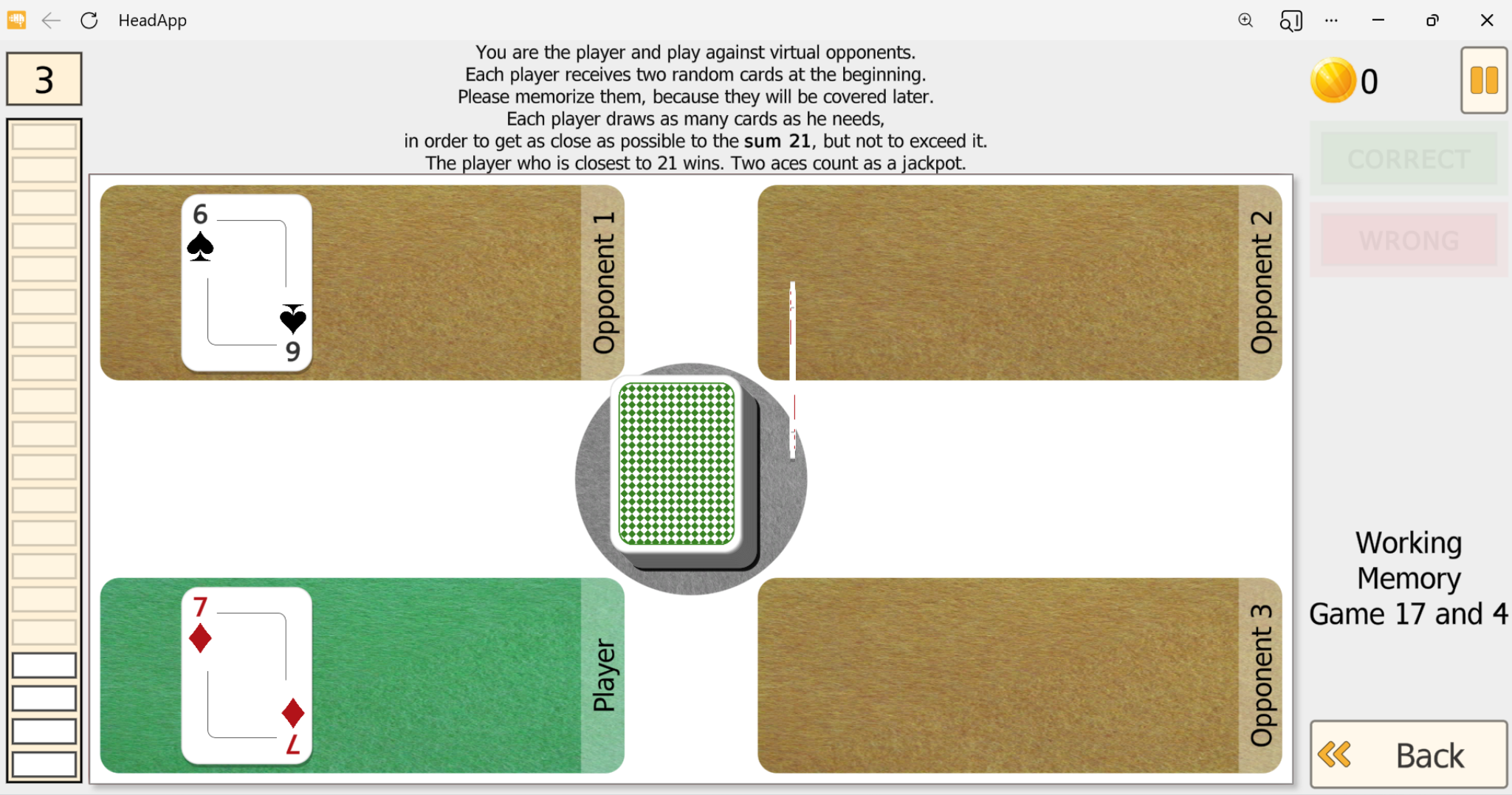
Working Memory Game "17 and 4"
What is Trained
Working memory updating in a strategic context with multiple information streams (self + opponents).
Patient/Client Task
A Blackjack-style game adapted as a memory task. The patient must remember and update card totals across multiple stacks while trying to get close to 21 without going over.
Clinical Note
This program includes a chance component, which can increase engagement, but may not be ideal for patients with low frustration tolerance or very impaired working memory.
Experience the Working Memory Modules
Start Therapist Free Trial.
Try N-Back, Verbal WM, Visual WM, Verbal-Visual WM, 17 and 4, and all other programs.