Rehabilitation

Comprehensive Cognitive & Language Enhancement Suite

Cognitive training that's tailored to individual needs.

HeadApp gives clinicians a structured set of training programs across 5 clinical domains with 23 programs, 37 cognitive exercises, and 53 language exercises. Each module targets a specific therapeutic goal, adjusts difficulty automatically, and provides clear performance data to support individualized treatment planning for both in-clinic sessions and structured home training.

Integrated cognitive screenings identify strengths and weaknesses and automatically generate a targeted training battery from HeadApp's program library, so clinicians don't have to manually choose the most appropriate exercises for each patient.

Patient and therapist sharing a happy moment during a cognitive rehabilitation session

Training Programs At a Glance

Five domains covering the core spectrum of cognitive and language rehabilitation.

5

Domains

23

Programs

37

Cognitive Exercises

53

Language Exercises

Attention

Prefrontal & parietal cortex, reticular activating system
Explore Exercises
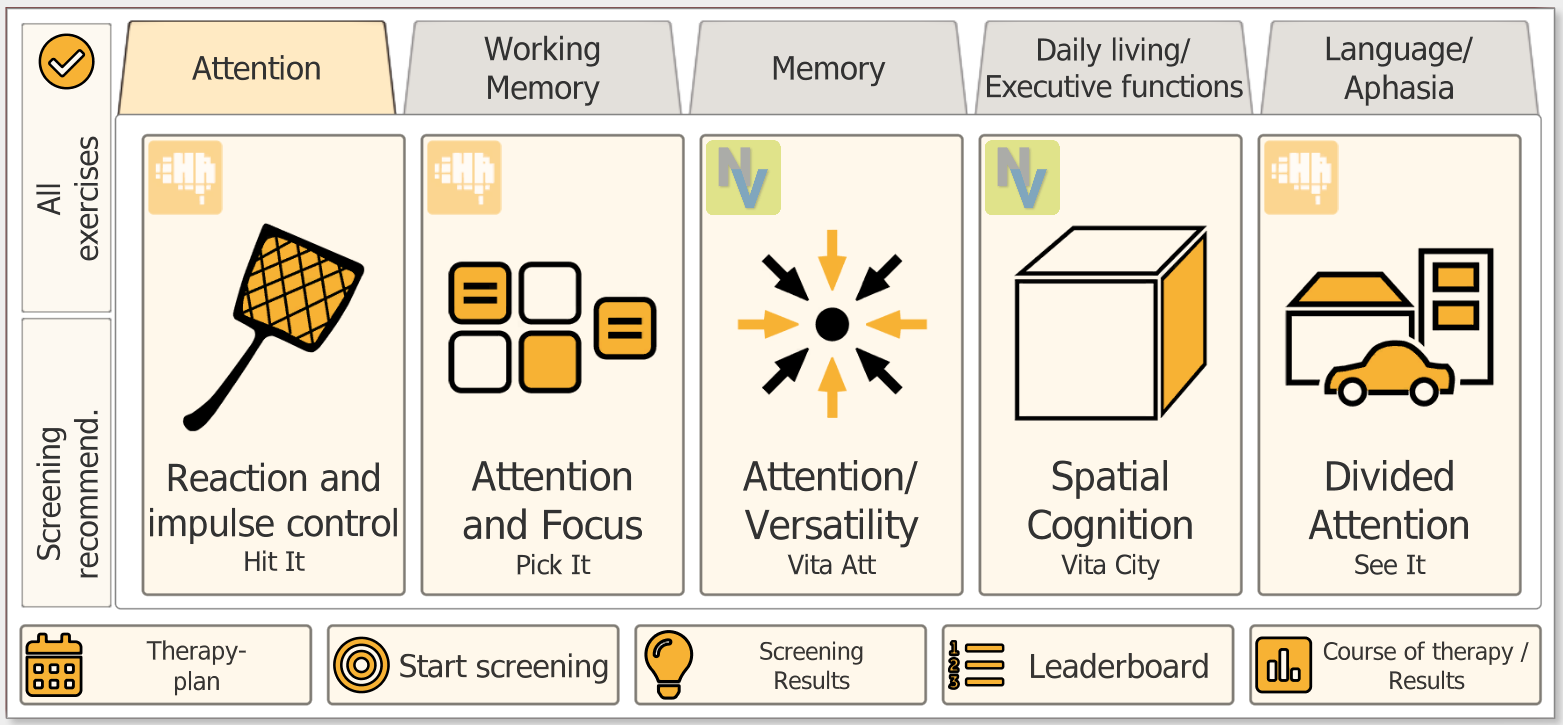
HeadApp Attention module showing Hit It, Pick It, Vita Att, Vita City, and See It exercises

Hit It → Pick It → Vita Att → Vita City → See It

Attention is the foundation for all continuing cognitive therapy. The five attention modules systematically address alertness, selective, sustained, divided, and alternating attention.

Hit It offers two selectable modes: (1) an alertness-only reaction task, and (2) alertness + impulse control/selection, adding inhibitory demands and distractor-based selectivity. This lets clinicians separate basic alerting/processing-speed work from higher-level response control.

Pick It emphasizes focused attention via target detection among similar items, strengthening selective attention and interference control.

Vita Att builds attention flexibility by requiring continuous marking decisions based on changing inclusion/exclusion rules, training sustained attention, set maintenance, and shifting.

Vita City primarily targets spatial cognition, but it also drives sustained, goal-directed scanning while planning efficient routes under constraints.

See It increases divided-attention demands by having users encode complex street scenes and answer multiple-choice questions, reinforcing multi-feature monitoring and selection of task-relevant details.
Working Memory

Dorsolateral prefrontal cortex, posterior parietal cortex

Explore Exercises
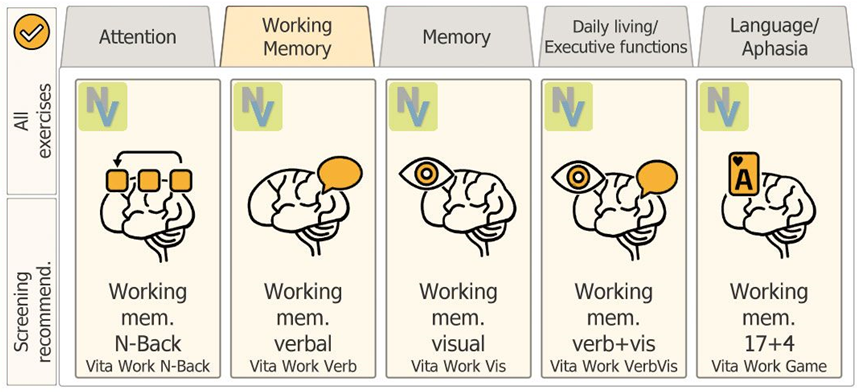
HeadApp Working Memory module with N-Back, verbal, visual, and combined exercises

WM n-Back → Verbal WM → Visual WM → Verbal-Visual WM → WM "17 and 4"

The working memory modules train maintenance, continuous updating, and binding of information under increasing load to support concentration, thinking, and learning.

n-Back uses briefly presented playing cards and asks users to detect repeats (card, color, or point value), directly targeting online updating and monitoring.

Verbal WM requires encoding verbal card contents, continuously updating them, and retrieving them under queries of varying complexity, supporting controlled retrieval and interference resistance.

Visual WM trains visuospatial working memory by tracking changing card locations, strengthening precision for positions.

Verbal-Visual WM adds feature-binding by linking card values to locations and recalling them in order, reinforcing sequencing within WM.

"17 and 4" applies a Black-Jack-like rule set to increase manipulation and mental tracking demands in a functional, game-like format.

Memory

Hippocampus, medial temporal lobe, thalamus

Explore Exercises
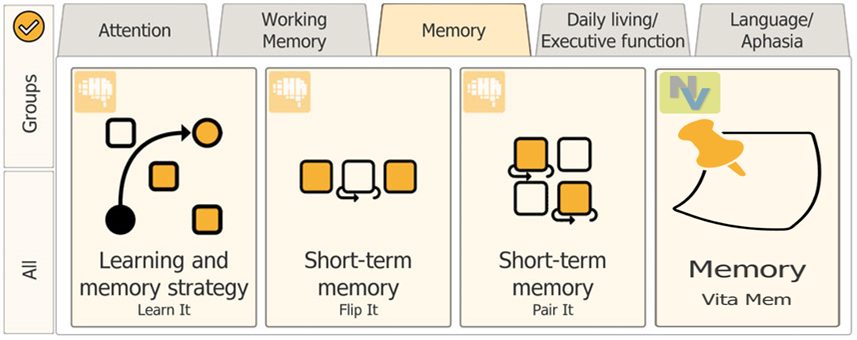
HeadApp Memory module with Learn It, Flip It, Pair It, and Vita Mem exercises

Learn It → Flip It → Pair It → Vita Mem

HeadApp's memory training emphasizes strategy-based encoding plus short-term recognition and associative organization to improve acquisition and retrieval.

Learn It teaches practical memory strategies patients can use in daily life. With evidence-based methods such as PQRST and the Method of Loci, it supports stronger encoding, more reliable retrieval, and better transfer to real-world situations.

Flip It trains short-term memory, visual scanning, and fast retrieval by asking users to remember information and locate it again after it is hidden. Flexible task modes make it suitable for both cognitive rehabilitation and aphasia-focused therapy.

Pair It strengthens memory and attention through a familiar matching format that becomes more challenging as the number and similarity of cards increase. This creates an engaging training experience that supports retention, recognition, and efficient search behavior.

Vita Mem combines memory practice with semantic processing by linking items to meaningful categories. The result is a more functional form of memory training that supports organization, associative thinking, and everyday recall.

Executive Functions / ADLs

Prefrontal cortex, anterior cingulate, basal ganglia

Explore Exercises
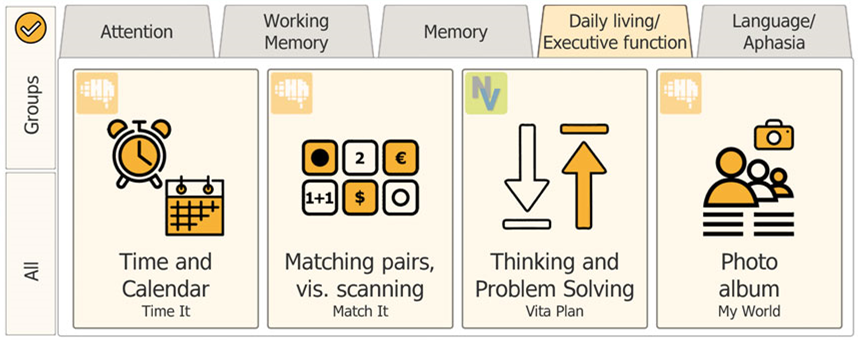
HeadApp Executive Function module with Time It, Match It, Vita Plan, and My World

Time It → Match It → Vita Plan → My World

Executive function and everyday cognition modules focus on planning, sequencing, constraint management, and functional problem-solving.

Time It trains time estimation, understanding/"calculating" clock time, and calendar comprehension across three modes -- highly relevant for everyday time management.

Match It increases cognitive load through rule-based matching under broad visual scanning demands, adding complexity via calculating, money-related tasks, and mental rotation while training selective, divided, and visuospatial attention.

Vita Plan requires sorting appointments into a day planner while respecting order and duration, strengthening planning, sequencing, and rule adherence.

My World is an occupation-based training module that enables therapists to create personalized therapy tasks using real-life photos or select from a wide range of ready-made templates with common daily routines. It allows patients to practice meaningful activities such as self-care and everyday task sequences in a structured and measurable way.

Language / Aphasia

Broca's & Wernicke's areas, arcuate fasciculus, angular gyrus

Explore Exercises
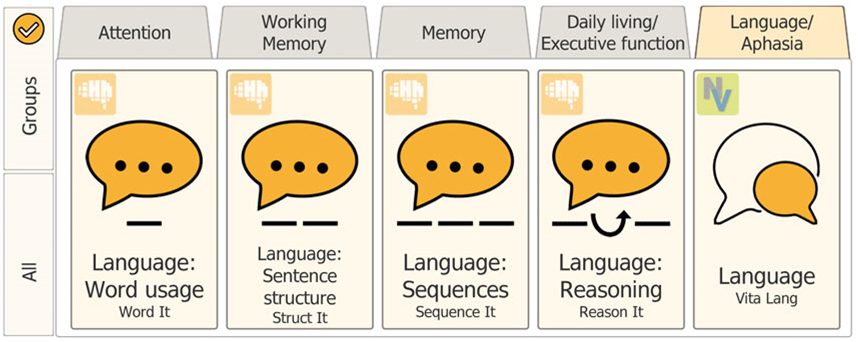
HeadApp Language and Aphasia module with Word It, Struct It, Sequence It, Reason It, and Vita Lang

Word It → Struct It → Sequence It → Reason It → Vita Lang

The language suite targets lexical-semantic processing, morphosyntax, sequencing for production, and verbal reasoning -- relevant for aphasia and broader neurogenic language disorders.

Word It trains word use through synonyms, antonyms, homonyms, vocabulary, word groups, and abbreviations, strengthening semantic networks and controlled lexical selection.

Struct It focuses on grammar and idioms to support sentence-level formulation and comprehension.

Sequence It trains ordering across letters, syllables, words, sentence parts, and full sentences, supporting sequencing for both comprehension and production.

Reason It targets inferencing and concept precision by selecting the correct word based on conclusions and meaning constraints, strengthening semantic integration.

Vita Lang reinforces organized lexical retrieval via categorization tasks, category-member search, and constrained entry formats (including crossword-style), supporting semantic fluency and structured retrieval strategies commonly used in SLP treatment.

Key Features

Adaptive Difficulty

Training automatically adjusts challenge levels based on patient performance, supporting neuroplastic learning.

Therapist-Controlled Parameters

Adjust duration, difficulty, and task settings to match individual therapy goals.

Progress Tracking

Detailed performance data and progress graphs for precise treatment adjustments.

15 Languages

Support international teams and multicultural patient populations seamlessly.

Cognitive Enhancement with 3 Simple Steps

From assessment to measurable outcomes -- a clear, structured pathway.

1

Screen Your Patient

Assess which cognitive deficits the patient may have and which degree of severity can be found.

2

Proceed Recommended Training Protocol

Based on the screening results, a personalized training recommendation will be automatically displayed with a battery of the most suitable training programs. To achieve the best results, the following training duration and frequency is recommended: 20 to 45 minutes per day, 3 to 5 days per week.

3

Monitor and Track Results

Track progress by evaluating results; success of the therapy can be monitored by repeating the screenings. For every test, there are three parallel versions; however, to prevent the impact of learning effects, a test cannot be repeated within one month after its initial completion.

Recommended Training Protocol

To achieve the best results, the following training duration and frequency is recommended:

20 - 45

minutes per day

3 - 5

days per week

Available in 15 languages

EnglishSpanishGermanFrenchPolishItalianPortugueseTurkishKoreanCzechSlovakLatvianLithuanianRussianUkrainian

Build Better Cognitive Training Plans

Get started with personalized training programs. Free trial available -- no credit card required.